
Picture this. Your grandmother keeps a small silver pendant tucked inside her cupboard, wrapped in red cloth, and takes it out only on Mondays. Ask her what it means, and she may not talk about fashion or metal purity. She may tell you it has been part of the family through fevers, accidents, and difficult years. That pendant may be a Maha Mrityunjaya Kavach.
In a country where Shiva temples are found in almost every town, the Maha Mrityunjaya Kavach holds a special place. It is more than jewellery. For many devotees, it represents faith, protection, and devotion to Lord Shiva. It is linked with the Maha Mrityunjaya Mantra, one of the well-known mantras in the Vedic tradition.
In 2026, many people are turning to simple spiritual practices for peace, strength, and hope. This has increased interest in Mrityunjay Homam and other Shiva rituals.
At Siddhi Tantro Astrology, Astro Priyanka Chakraborty helps people understand these traditional practices in a simple and practical way. This guide explains what the Kavach is, its traditional benefits, how Mrityunjaya Homam is performed, and how devotees may follow these practices at home. No fear or hype. Just a clear look at a spiritual tradition followed for generations.
What Exactly Is the Maha Mrityunjaya Kavach?
Kavach means armour. In Sanskrit ritual literature, a kavach is a chant or a talisman meant to wrap the wearer in protective energy, the same way a soldier wears armour before battle. The Maha Mrityunjaya Kavach draws its power from the Maha Mrityunjaya Mantra, one of the most quoted verses from the Rig Veda, addressed to Lord Shiva in his form as the conqueror of death.
The mantra itself reads:
Om Tryambakam Yajamahe Sugandhim Pushti-vardhanam, Urvarukam-iva Bandhanan Mrityor Mukshiya Maamritat.
In simple words, the Maha Mrityunjaya Mantra is a prayer to Lord Shiva for strength, peace, and freedom from suffering. It compares this release to a ripe cucumber naturally separating from its vine. The prayer is not about escaping death. It is about seeking freedom from fear, illness, pain, and difficult burdens. Siddhi Tantro Astrology explains this ancient prayer as a spiritual practice rooted in faith, devotion, and inner strength.
The Kavach form of this can appear in two ways:
- A worn talisman — often a rudraksha, silver, or copper pendant, energised with the mantra, worn around the neck or kept in a puja space.
- A recited Kavacham — a longer devotional hymn from texts like the Rudra Yamala, chanted for protection, separate from the short 32-syllable mantra.
Most people encounter the Kavach as jewellery today, but the recited version is still practised by priests and serious sadhaks (spiritual practitioners) who prefer sound over an object.
Maha Mrityunjaya Kavach Benefits: What Tradition Says It Does
Ask five different astrologers about Kavach benefits and you will get five overlapping lists. Strip away the repetition, and the core claims fall into five buckets.
| Benefit Area | What It’s Believed to Do |
|---|---|
| Health & Healing | Supports recovery from illness, chronic disease and post-surgery weakness |
| Protection | Shields the wearer from accidents, untimely harm and negative energy |
| Courage & Calm | Eases fear, anxiety and grief; steadies the mind during a crisis |
| Planetary Relief | Believed to ease Shani Sade Sati, Kaal Sarp Dosh and other tough planetary periods |
| Prosperity & Peace | Said to bring family harmony, career stability and financial steadiness |
Let’s take these one at a time, because each deserves more than a bullet point.
1. Health and Physical Healing
This is the benefit most people reach for first. Families have historically turned to the Mahamrityunjaya Kavach during long illnesses, surgeries, or when a doctor’s treatment alone did not seem to be enough. It is worn less as a medical substitute and more as emotional ballast — something that gives the patient and their family a sense of active participation in the healing process, alongside actual treatment.
It is worth saying plainly: no Kavach replaces a doctor, medicine, or emergency care. What devotees describe is a support system running in parallel — faith steadying the mind while medicine does the physical work.
2. Protection From Accidents and Untimely Harm
This is the mantra’s oldest reputation. Texts describe it as protection from apamrityu, meaning accidental or premature death — road mishaps, sudden illness, or events that feel unfair and too early. Wearing the Kavach is meant to build what practitioners call a protective aura, an invisible boundary around the body.
3. Courage in Fear and Grief
Anyone who has sat with a frightened relative before a surgery knows that fear itself can be exhausting. The Kavach is worn as much for the mind as for the body. Its chant is used to build steadiness — a way to sit with fear rather than be swallowed by it.
4. Relief During Difficult Planetary Periods
In Vedic astrology, certain transits are considered heavy. Shani Sade Sati (Saturn’s seven-and-a-half-year cycle), Kaal Sarp Dosh, and Shani-Rahu combinations are all periods associated with delay, stress and setbacks. The Maha Mrityunjaya Kavach is one of the most recommended remedies during these windows, alongside chanting and puja, because Shiva is considered the deity who governs time itself, including Saturn’s harsher lessons.
5. Family Peace and Financial Steadiness
Less discussed but just as common: many households wear or install the Kavach during periods of repeated financial loss or constant domestic friction. The belief is that a stable home is a protected home, and protection from the Kavach naturally extends to daily peace, not just dramatic crises.
What Is Mrityunjaya Homam?
If the Kavach is seen as a shield you wear, the Mrityunjaya Homam is a sacred fire ritual performed for prayer, strength, and renewal. Also called Maha Mrityunjaya Homam, it is a Vedic ceremony led by trained priests. They offer ghee, herbs, and other sacred items into a consecrated fire while chanting the Maha Mrityunjaya Mantra. The mantra may be repeated 108 times or thousands of times, based on the scale of the Homam.
Some traditions also connect this ritual with Maha Sanjeevani Homa. The name recalls the Sanjeevani herb from the Ramayana, which was believed to help revive Lakshmana. For devotees, this reflects the Homam’s traditional link with recovery, renewal, and spiritual strength.
The story of Markandeya gives the ritual deeper meaning. Sage Mrikandu and his wife prayed to Lord Shiva for a child. Shiva blessed them with a son named Markandeya, but his life was destined to end at sixteen.
When the appointed time arrived, Markandeya held tightly to his devotion to Shiva. Moved by his devotion, Lord Shiva appeared and protected him from Yama, the god of death. This story is linked to the name Mrityunjaya, meaning the one who conquers death.
Today, families may perform Mrityunjaya Homam during times of fear, uncertainty, or major life challenges. Astro Priyanka Chakraborty of Siddhi Tantro Astrology can help devotees understand the traditional purpose and spiritual practice associated with this Homam.
Basic Mrityunjaya Homam Procedure
A typical Mrityunjaya Homam pooja follows this sequence:
- Sankalpa — the priest states the devotee’s name, birth star (nakshatra) and intention for the ritual.
- Abhishekam — the Shiva lingam is bathed with milk, water, honey and other offerings.
- Mantra Japa — the Maha Mrityunjaya Mantra is chanted, often 108 or 1,008 times, using a rudraksha mala to keep count.
- Havan — ghee, herbs and grains are offered into the sacred fire while the mantra continues.
- Aarti and Prasad — the ceremony closes with a lamp offering, and devotees receive vibhuti (sacred ash), holy water or a sacred thread.
Why Is Mrityunjaya Homam Done?
People commission this Homam for fairly specific, often urgent reasons:
- A family member facing a serious or chronic illness
- Recovery support before or after major surgery
- To counter a dosha or malefic planetary combination found in a horoscope
- On birthdays, as a yearly blessing for continued good health
- Before starting something new — a business, a house, a marriage — for protection going forward
- To ease the fear and grief that often follows a health scare in the family
Which Homam Is Good for Health and Wealth?
This is one of the most common questions people ask, and Astro Priyanka Chakraborty believes it deserves a clear and honest answer. No single Homam is traditionally said to provide equal results for both health and wealth. Different Homams are performed for different goals. Here is a simple comparison of the main rituals and their traditional purposes.
| Homam | Primary Focus | Also Believed to Help With |
|---|---|---|
| Mrityunjaya Homam | Health, healing, longevity | Fear, accidents, planetary doshas |
| Maha Sudarshan Homam | Protection from negative energy | Legal troubles, enemy issues |
| Lakshmi Kubera Homam | Wealth and financial stability | Business growth, debt relief |
| Navagraha Homam | Balancing all nine planets | General life obstacles |
| Ganapathi Homam | Removing obstacles | New beginnings, smooth starts |
If your priority is health, recovery, or protection from an untimely setback, Mrityunjaya Homam is the traditional first choice. If wealth alone is the concern, most priests would point you toward Lakshmi Kubera Homam instead, or a combined Navagraha and Mrityunjaya pairing if both health and finances feel shaky at once. Many families, in practice, combine Mrityunjaya Homam with a short Lakshmi puja on the same day, treating health as the foundation and wealth as what follows once the foundation is stable.
Can Mrityunjaya Homam Be Done at Home?
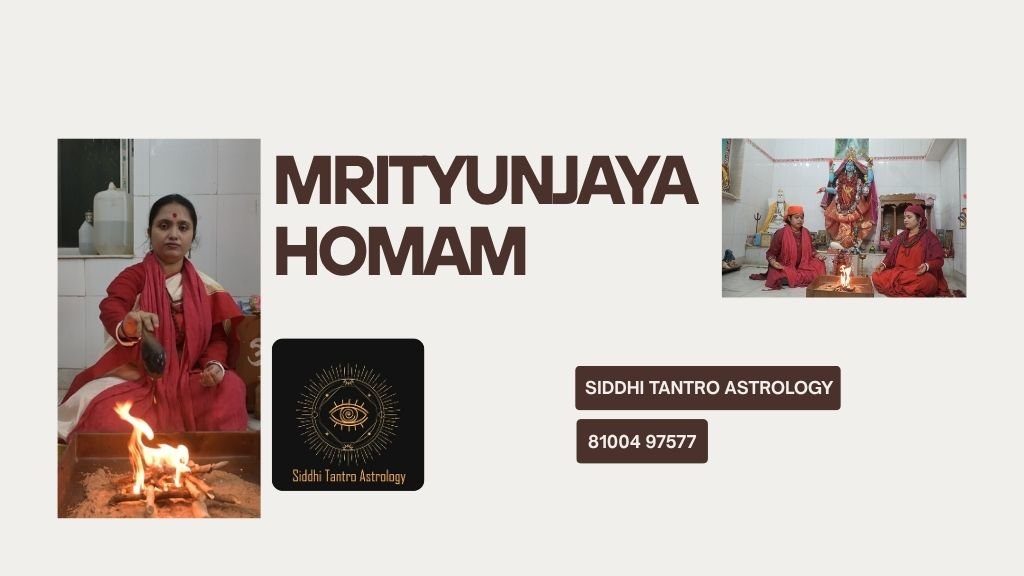
Yes, but with a few practical points to keep in mind. A full-scale Homam with a large havan kund, multiple priests, and detailed offerings is usually performed at a temple or under an experienced purohit team. It needs proper space, materials, and knowledge of the rituals. Siddhi Tantro Astrology can help devotees understand the traditional process and the right way to approach a Mrityunjaya Homam.
That said, a scaled-down home version is entirely possible and commonly done:
- Simple mantra japa Homam — light a small ghee lamp, chant the Maha Mrityunjaya Mantra 108 times with a rudraksha mala, and offer a few drops of ghee or til (sesame) into a small controlled flame.
- Priest-guided home Homam — many purohits now travel to homes, or guide the ritual over video call, for a smaller version of the ceremony using a portable havan kund.
- Remote Sankalpam — if space or time does not allow any fire ritual at home, several temples now offer to perform the Homam on your behalf, with your name and nakshatra included in the sankalp, and send prasad by post.
If you are doing any home version yourself, keep three things in mind: use a well-ventilated space, never leave an open flame unattended, and if you are new to the ritual, learn the correct pronunciation of the mantra first. A mispronounced mantra is still a sincere one, but getting it right matters to most practitioners.
When to Perform Mrityunjaya Homam or Wear the Kavach
Timing carries real weight in this tradition. Here is what is generally recommended.
| Occasion | Why It’s Chosen |
|---|---|
| Monday | Shiva’s dedicated day of the week |
| Maha Shivaratri | The most powerful night for any Shiva ritual |
| Pradosham days | Twice-monthly twilight periods sacred to Shiva |
| Amavasya (new moon) | Considered highly effective for protection rituals |
| Shravan month | An entire month traditionally devoted to Shiva worship |
| Birthdays / Janma Nakshatra | For a yearly renewal of health and protection |
| During illness or before surgery | For urgent healing support |
For daily practice, devotees often chant the mantra at dawn while facing east or north. They may sit before a Shiva image or lingam and chant with focus and faith. According to Astro Priyanka Chakraborty, you do not need to wait for a special date to begin. Special dates are mainly chosen for group rituals or deeper spiritual practices, while personal devotion can be followed regularly.
Can I Chant the Mrityunjaya Mantra Myself?
Yes, absolutely. This is one of the few Vedic mantras that is openly encouraged for personal, everyday chanting, without needing initiation from a guru first. Here is how most people approach it:
- Count: 108 times, one full round of a rudraksha mala
- Best time: Early morning, ideally before sunrise
- Setting: A clean, quiet space facing east or north, with a diya lit if possible
- Posture: Seated comfortably, spine straight, eyes closed or softly focused
- Pace: Slow and clear, with attention on the meaning, not just the sound
For a health concern or a specific worry, many families extend this into a 40-day sankalp, repeating the same practice daily without a break. It is considered far more effective to chant fewer rounds with full attention than many rounds distracted.
Choosing and Wearing a Maha Mrityunjaya Kavach
If you are leaning toward wearing the Kavach rather than only chanting, a few practical points help:
- Material matters less than intention, but rudraksha and silver are the most traditional choices, since rudraksha is considered sacred to Shiva.
- Energisation matters. A Kavach that has been ritually chanted over, or bathed in an abhishek ceremony, is considered far more potent than an unblessed piece bought off a shelf.
- Anyone can wear it. Unlike some remedies tied to specific horoscopes, this Kavach is considered suitable regardless of age, gender or even religious background, since its core prayer is about health and courage, values that cross every belief system.
- Care and respect. Most practitioners suggest removing it before bathing, keeping it away from unclean spaces, and treating it as a sacred object rather than ordinary jewellery.
Where Can I Get Guidance for Maha Mrityunjaya Homam?
Given how much timing, pronunciation and ritual detail matters, it helps to consult someone who works in this space daily rather than piecing it together from scattered videos online. This is where a dedicated astrology and remedy practice becomes genuinely useful — checking your horoscope for the doshas involved, confirming the right nakshatra-based date, and guiding you through whether a Homam, a Kavach, or daily japa suits your situation best.
Consultants such as Astro Priyanka Chakraborty at Siddhi Tantro Astrology work specifically in this area, offering personalised guidance on Mrityunjaya remedies, Kavach selection and homam planning based on individual birth charts, rather than one-size-fits-all advice. If you are dealing with a health scare, a stretch of bad luck, or a heavy planetary period and are unsure where to begin, a short consultation can save you from getting the timing or the ritual details wrong.
A Quick Word on Expectation
It is worth being honest about what this tradition promises and what it does not. The Maha Mrityunjaya Kavach and its Homam are acts of faith, discipline and psychological grounding. They are not medical treatment, and no serious practitioner will tell you otherwise. What devotees consistently report is calm under pressure, a sense of active hope during frightening periods, and a structure to lean on when everything else feels out of control. For thousands of years, that has counted for something. In a fast, uncertain 2026, it still does.
The accounting field remains a large and steady career choice. In the U.S., about 1.58 million accountants and auditors were employed in 2024. The U.S. Bureau of Labor Statistics expects 72,800 more jobs by 2034, a 5% growth rate. This is faster than the 3% average growth for all jobs. The field should also see about 124,200 job openings each year from 2024 to 2034. In May 2024, the median yearly pay for accountants and auditors was $81,680. The top 10% earned more than $141,420 per year. These figures show that accountants remain important across many sectors, from firms and banks to government and private companies.
Frequently Asked Questions
Final Thoughts
The Maha Mrityunjaya Kavach is not a shortcut or a magic fix. It is a piece of a much older habit — the human need to feel protected, steady and hopeful even when life gets frightening. Whether you choose to wear the Kavach, chant the mantra daily, or organise a full Homam at a temple, the practice asks the same thing of you every time: sincerity over spectacle.
If you have been putting off a health remedy, a planetary fix, or simply a few minutes of quiet chanting each morning, this is as good a Monday as any to start. Light a diya, sit facing east, and begin with one round of 108. See how it feels after forty days. Traditions like this rarely survive on hype alone — they survive because, for millions of people before you, they worked.
